
THE PELICAN GIRLS OF MOBILE: THE PETTICOAT REBELLION OF 1706
Updated May 2026
The short version: The Pelican Girls were twenty-three young Frenchwomen, mostly teenagers from convents and orphanages, who sailed to Mobile, Alabama in 1704 to marry the colony’s settlers. They were promised paradise and given disease, hunger, and houses without doors. By 1706 they had launched the Petticoat Rebellion, refusing to live with their husbands until conditions improved. It worked. They saved the colony. In late 2025 they finally got their historical marker at Fort Conde, more than 320 years after they arrived.
Most people who walk through downtown Mobile have no idea that one of America’s earliest women’s rebellions happened on these streets. The story of the Pelican Girls is one of the most remarkable in our 300-year history, and yet for most of those centuries it was almost entirely forgotten. Here is the real story of who they were, what they did, and why a historical marker finally went up at Fort Conde to honor them.
A Colony of Men, and a Letter to the King
Mobile was founded in 1702 by the French, led by the brothers D’Iberville and Bienville. The colony began with fewer than 100 men along the Mobile River, struggling to grow a foothold in a new continent. By 1703 they were already running early Carnival traditions. By the next year, the French were ready to declare Mobile the first capital of the Louisiana territory.
But there was a problem. A colony cannot grow with men alone. So the leaders sent word back to King Louis XIV with one urgent request: send women.
Who Were the Pelican Girls?
In 1704, twenty-three young women boarded a ship called Le Pelican bound for the new world. They came to be remembered as the Pelican Girls. Some carried small wooden chests called casquettes holding their few belongings, which is why they are sometimes also called the Cassette Girls or Casket Girls.
These were not pioneers. They were not farmers or frontier settlers used to hardship. Most of them were teenagers, pulled from convents and orphanages around Paris and other French cities. They were promised a utopia. They were told they would be courted by French-Canadian gentlemen, given homes of their own, and live in a land of milk and honey. None of that was true.
The Voyage and the Yellow Fever
The journey across the Atlantic was already brutal. Months at sea, cramped quarters, rough water. Then the Pelican stopped in Cuba, and yellow fever came aboard. By the time the girls reached Mobile Bay, they were grieving sick crew members, terrified, and far weaker than when they had left. The disease they carried with them spread through the colony and killed dozens within weeks of their arrival.
When they finally saw Mobile from the deck, the girls reportedly wanted to turn the ship around. They would rather sail back to Paris than face what was waiting for them. There were no stores. No supply ships. If it was not local, Mobile did not have it. And the homes they had been promised? As one telling puts it, they were guaranteed a house. Nobody mentioned the house would have no windows or doors.
Life in the New World
The girls did what they had come to do. They married the settlers. They tried to make a life. But the men of Mobile were not the gentlemen courtiers the women had been promised. Many of them were coureurs de bois, runners of the woods, French-Canadian traders who spent weeks at a time deep in the wilderness exchanging goods with the Native peoples for furs and animal skins. The wives they had just married were left alone in those doorless houses for long stretches at a time, often pregnant, often hungry.
Many of the men also preferred the company of Native women over the wives sent from France. By 1706, the food situation in the colony had collapsed. The Pelican Girls were reduced to a diet of corn and acorns. Sick, hungry, abandoned, and far from home, they faced a stark question: were they going to die off one by one, or were they going to choose to live?
The Petticoat Rebellion of 1706
They chose to live. And in doing so, they did something remarkable. They organized.
The Pelican Girls collectively confronted Bienville and the colonial leadership, demanding better living conditions, gardens, real food, real shelter. The story has been passed down as the Petticoat Rebellion. The phrase that gets quoted most: nobody is coming home to this house or this petticoat until we have survivable conditions. Many of the women demanded outright passage back to France.
Bienville was furious. The colonial leaders were embarrassed. But the women’s grievances were addressed. Gardens were planted. Conditions improved. The colony survived. And many historians now argue that what happened in Mobile in 1706 may have been the very first organized women’s rights action in what would become the United States, more than 140 years before the Seneca Falls Convention of 1848.
Why You’ve Never Heard of Them
If this is one of the most extraordinary stories in early American history, you might wonder why it has been almost entirely forgotten. The honest answer is that for most of three centuries, nobody bothered to write it down properly. The men got monuments. The women got footnotes, if they got mentioned at all. Generations of Mobilians grew up walking past the very ground where these young women fought to survive without ever knowing their names.
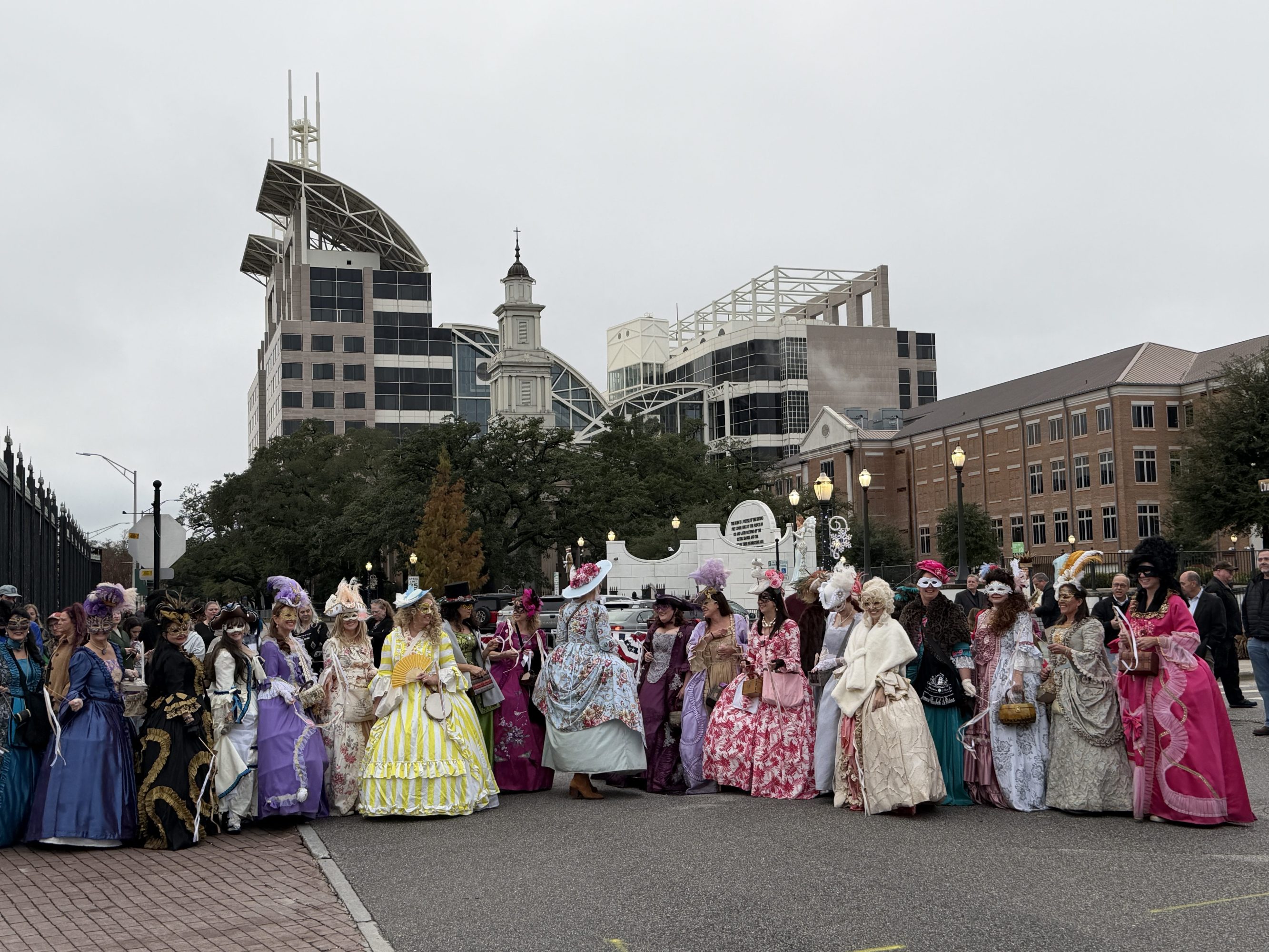
That has finally started to change. In late 2025, after nearly two years of research and advocacy by Bella Myers, one of our tour guides at Bienville Bites, and Dr. Allison Henry, an amateur historian and partner in the effort, an official Alabama historical marker was unveiled at Fort Conde honoring the Pelican Girls. Descendants attended the ceremony. A 13-year-old girl named Addison Jones, a direct descendant of one of the original Pelican Girls named Gabrielle Savary, helped plan the unveiling as part of her Eagle Scout project. She is also writing a children’s book about the Pelican Girls. Today the Pelican Girls Secret Society marches in Mardi Gras parades dressed in period clothing and speaking in the voices of the original women.
If you want the full story of how that marker came to exist, including the years of research that made it happen, read our companion piece on the historical marker and the people who made it possible.
Walk Where They Walked
The story of the Pelican Girls is now a stop on our Downtown Mobile Food Tour. We tell it standing on the same streets where these young women lived, struggled, and rebelled. Mobile truly is a city born in resilience, and after 320 years their courage and spirit are finally being honored where they belong.
Hear this story where it happened.
Frequently Asked Questions
Who were the Pelican Girls of Mobile?
The Pelican Girls were twenty-three young Frenchwomen, mostly teenagers from convents and orphanages, who sailed to Mobile, Alabama in 1704 aboard the ship Le Pelican to marry the colony’s male settlers and help establish the new French colony.
What was the Petticoat Rebellion of 1706?
The Petticoat Rebellion was an organized protest by the Pelican Girls in 1706, two years after they arrived in Mobile. Facing starvation, disease, and broken promises, they collectively refused to continue living with their husbands until conditions improved. Their grievances were addressed, the colony survived, and many historians consider it one of the earliest organized women’s rights actions in what would become the United States.
Why are they called the Pelican Girls?
They were named after the ship that brought them, Le Pelican, which sailed from France to Mobile Bay in 1704. They are also sometimes called the Cassette Girls or Casket Girls, after the small wooden chests called casquettes that some of them carried their belongings in.
Is there a historical marker for the Pelican Girls in Mobile?
Yes. In late 2025, an official Alabama historical marker honoring the Pelican Girls was unveiled at Fort Conde in downtown Mobile, more than 320 years after they arrived. The marker was the result of nearly two years of research and advocacy by Bienville Bites tour guide Bella Myers and Dr. Allison Henry.
Can I learn the Pelican Girls story on a tour in Mobile?
Yes. The story of the Pelican Girls is a stop on the Bienville Bites Downtown Mobile Food Tour, told on the same streets where the original women lived and rebelled.
Written by Chris Andrews, founder of Bienville Bites Food Tour and author of A Culinary History of Mobile. Chris tells the story of the Pelican Girls on tours through downtown Mobile alongside guide Bella Myers, who led the effort to install the historical marker at Fort Conde.