
DOWNTOWN MOBILE: A WALKING GUIDE TO 300 YEARS OF HISTORY
Updated May 2026
Mobile was founded in 1702, which makes its downtown one of the oldest in America, older than New Orleans, older than the United States itself. You can walk the heart of it in an afternoon, and almost every building you pass has a story. This is a self-guided walk through that history, the same ground we cover (with food) on our tours. Wear comfortable shoes, look up at the cornices, and take your time.
A quick orientation: The French established Mobile in 1702, first at 27 Mile Bluff up the river, then moved it to the present location in 1711 after flooding. The settlement passed through six flags: French, British, Spanish, the Republic of Alabama, the Confederacy, and the United States. Bienville himself named the streets you’re about to walk: Royal, Dauphin, St. Francis.
Start: Dauphin Street, the Spine of the City
Begin on Dauphin Street, named by Bienville for the son of King Louis XIV. Under Spanish rule (1780 to 1813) it was called St. John or Galvez Street; the Americans renamed it Dauphin in 1813. By the 1830s, when Mobile was the third-busiest port in the nation on the strength of cotton, the street earned such a reputation that “like walkin’ down Dauphin Street” became local slang for anything of exceptional quality. A fire in 1839 destroyed the original wooden buildings, which is why the two- and three-story brick storefronts you see today began going up afterward.
The Van Antwerp Building
Dauphin & Royal
This ten-story landmark was Alabama’s first skyscraper and the first on the Gulf Coast, with ground broken in 1906. Garrett Van Antwerp had run a drugstore on this corner since 1888, and his new building featured a 53-foot white marble soda fountain billed as the finest in the United States. Famously, tenants were nervous about offices above the fourth floor, unaccustomed to working that high, so architect George B. Rogers moved his own practice to the top to prove it was safe. The building’s exuberant multicolored terra-cotta cornice has been beautifully restored by the Retirement Systems of Alabama.
The Battle House Hotel
26 North Royal Street
Across from the river stands the Battle House, recently named the Best Historic Hotel in the United States. It’s named for the three Battle brothers who built a hotel here in 1852, on the very site where Andrew Jackson kept his headquarters during the War of 1812. From the day it opened, it was the center of Mobile’s social scene, hosting the balls of the mystic parading societies. More presidents have stayed here than at any other hotel in the state, and Stephen Douglas slept here the night before losing the 1860 election to Lincoln. The original burned in 1905; the present building dates to 1908.
One story worth carrying with you: Mobile native Jimmy Buffett once recalled standing on his father’s shoulders outside the Battle House during an Order of Myths parade, where he had his first encounter with Carnival’s figures of Death and Folly. Death looked the boy in the eye and laughed, then, with a crack like a gunshot, Folly walloped Death with the traditional inflated pig bladders. The idea of celebrating life in the face of death stayed with Buffett as a life philosophy.
The RSA Tower & the Moon Pie
11 North Water Street
The contemporary RSA Tower (2006) is the tallest building in both the city and the state. Nearby hangs the World’s Largest Electronic Moon Pie, which Mobile drops every New Year’s Eve to ring in the year with a street party. Mobile and the moon pie are inseparable, locals eat an estimated four million a year, and the city serves as the national test market for new flavors.
Looking Toward the River
From the foot of Royal Street, look toward the Mobile River. This was the original waterfront; when the Americans took Mobile after the War of 1812, they found Fort Conde in disrepair, demolished it, and used the debris to fill in the land between here and the river. The river has always been a working one, cotton in the 19th century, bananas around 1900, an explosion of shipbuilding in World War II. And it was here that Malcolm McLean’s idea of lifting whole truck trailers onto ships gave birth to the modern shipping container, growing Mobile’s port into the tenth largest in the country.
Bienville Square
Walk up to Bienville Square, downtown’s green heart, named for the city’s founder. Congress granted this land, the old Spanish Hospital plot, to Mobile on the condition it remain a public park forever. In the early days it was rough ground where people grazed livestock and hung laundry; by the 1850s the city added sidewalks, benches, a cast-iron fence, and new live oaks, some of which still stand and are said to be over 200 years old. The fountain (1890) honors Dr. George Ketchum, who brought safe drinking water to Mobile, and Teddy Roosevelt spoke here in 1905 about the Panama Canal’s importance to the port.
This is also the place to tell the real story of Bienville. To earn the trust of the Mauvilla people, who gave Mobile its name, he would strip to a loincloth, canoe upriver, and have them tattoo him; explorers wrote he was covered head to toe and partial to snakes. The natives, who taught the French to grow corn, beans, and squash, arguably shaped Bienville as much as he shaped the region. The cuisine and the Carnival we celebrate both descend from that early exchange.
The A&M Peanut Shop & Three George’s
Near the square, follow your nose to the A&M Peanut Shop, where a roaster has run since 1907 (the shop itself opened in 1947). A few doors on is Three George’s, a downtown chocolate and candy institution since 1917, founded by three Greek immigrants all named George. When Mobile native Winston Groom’s Forrest Gump was filming, Three George’s shipped chocolate-covered shrimp to the set for Tom Hanks and Sally Field, which is about as Mobile a piece of movie trivia as exists.
Cathedral Square & the Basilica
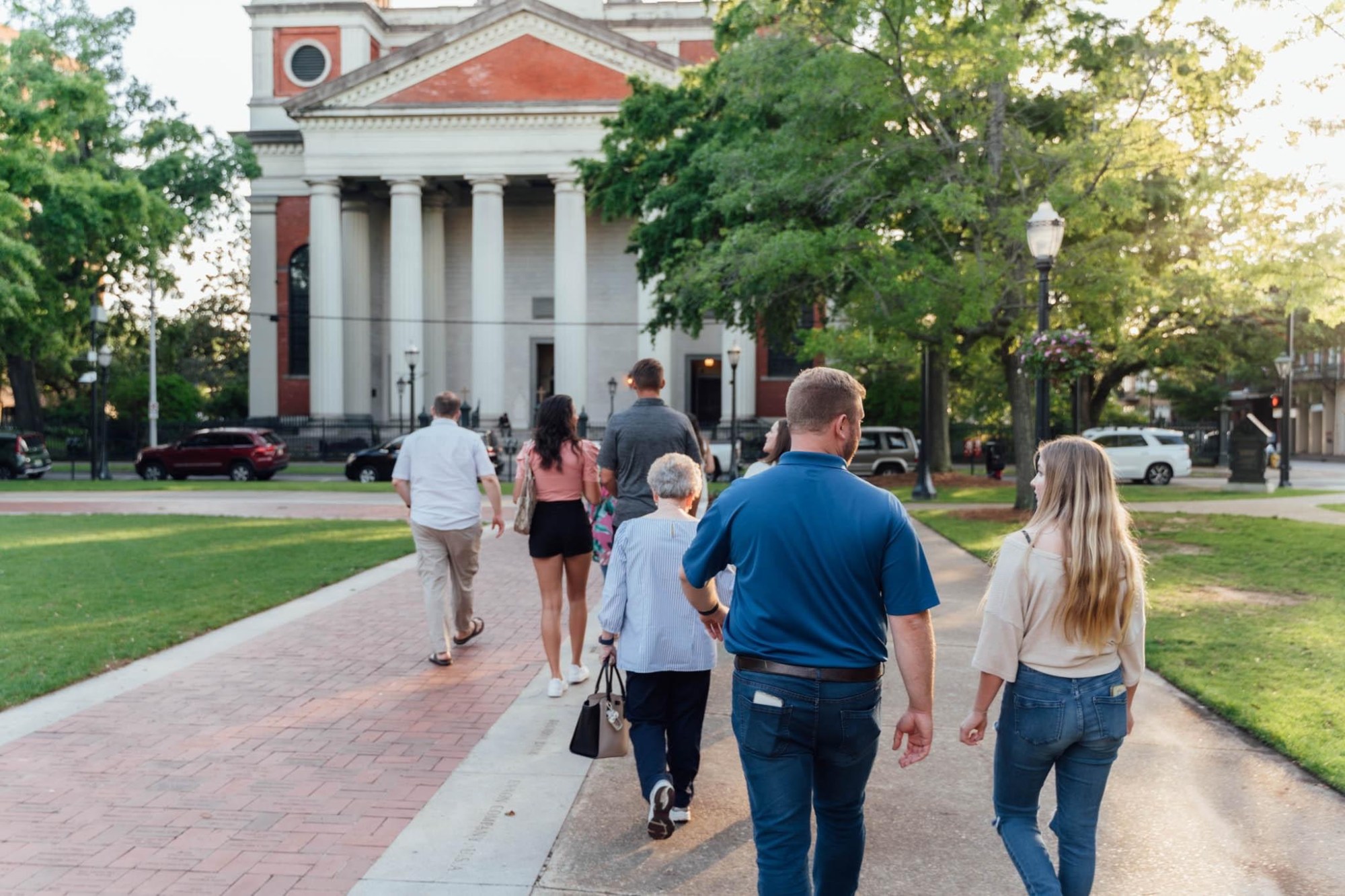
Continue to Cathedral Square, dominated by the Cathedral of the Immaculate Conception. Dauphin Street originally ended here at the old Campo Santo cemetery. The first Catholic congregation in Alabama formed at Mobile’s original 27 Mile Bluff site in 1703, the oldest religious congregation in the state, and the cathedral was finished in 1850, when it was the tallest building in town. Bishop Portier, who built it and went on to found Spring Hill College, is buried in the crypt beneath. His 1834 Creole cottage still stands nearby.
The Saenger Theatre
6 South Joachim Street
End at the Saenger Theatre, a 1927 movie palace by architect Emil Weil, rich with French and Italian Renaissance ornamentation and restored to its original grandeur. It still hosts films, concerts, and live performances throughout the year, a fitting finale for a walk through three centuries of Mobile.
Walk It With Us (and Eat Along the Way)
This is the same historic ground we cover on the Downtown Mobile Food Tour, except we stop at seven restaurants and shops, and you hear the stories with a plate (and a drink) in hand. If you’d rather have the history served with the food, come walk it with us.
History tastes better with a fork in your hand.
Frequently Asked Questions
What is there to do in downtown Mobile?
Downtown Mobile is built for walking: historic Dauphin Street, the Battle House Hotel, Bienville Square, Cathedral Square and the Cathedral Basilica, the Saenger Theatre, and dozens of 19th-century buildings. A guided food tour is the best way to combine the history with the city’s Gulf Coast cuisine.
Is downtown Mobile walkable?
Yes. Downtown Mobile is flat and compact, and you can walk the core historic district, from the riverfront through Dauphin Street to Cathedral Square, in an afternoon. Comfortable shoes are recommended, as you’ll cover a lot of ground.
What are the oldest buildings in downtown Mobile?
Some of downtown Mobile’s oldest surviving structures date to the 1840s and 1850s, after an 1839 fire destroyed the original wooden buildings. Notable historic buildings include the Cathedral of the Immaculate Conception (finished 1850), the Joseph Silver House (1845), and the Battle House Hotel site (a hotel has stood here since 1852).
How old is Mobile, Alabama?
Mobile was founded by the French in 1702, making it older than New Orleans and one of the oldest cities in the United States. It was originally settled at 27 Mile Bluff up the Mobile River, then moved to its present downtown location in 1711.
Free Download
Taste the History Too
7 Iconic Mobile Dishes and the Surprising Stories Behind Them
You just walked 300 years of Mobile history. Now taste it. This free guide tells the stories behind seven dishes this city was built on, from the founder of Bienville Bites and author of A Culinary History of Mobile. Drop your email and it’s yours.
No spam, just good Mobile food stories. Unsubscribe anytime.
Written by Chris Andrews, founder of Bienville Bites Food Tour and author of A Culinary History of Mobile. Chris has guided thousands of visitors through downtown Mobile and knows every block, every building, and every good place to eat.